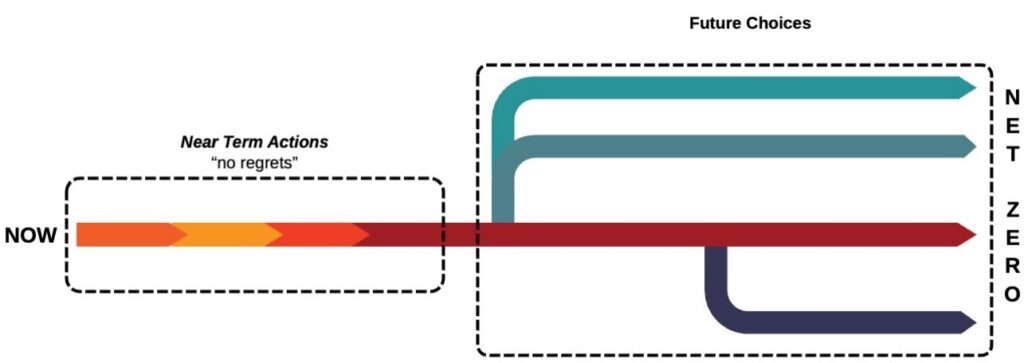
Energy Transition Strategies can apply to individual buildings, building portfolios, campuses and district energy systems. As the scale of the assets increase, the number of options and variables to consider as part of the transition plan increases, however the common elements of an actionable Energy Transition Strategy include:
- Developing an emissions baseline and growth forecast
- Completing a quantitative and qualitative evaluation of different transition pathways
- Identifying “no regrets” steps that can be taken in the near term to reduce emissions without impacting the range of future decarbonization options available
- Identifying future decision points and available options
- Developing a transition plan that is flexible and can respond to changing policies, technologies and economic conditions.
Reshape has supported several of our clients in developing energy transition strategies including:
- Developing a “Decarbonization Roadmap” for the City of Vancouver’s neighbourhood energy utility, the goal of which was to identify a preferred pathway to fully decarbonize the NEU’s heat supply in 2030 and maintain a 100% renewable energy supply as the system continues to grow. Reshape evaluated 11 different decarbonization pathways that the NEU could take to achieve carbon neutrality by 2030. These pathways were evaluated based on lifecycle cost, levelized cost of energy, emission factor, and a range of qualitative factors.
- Preparing a Long-Term Energy Transition Plan for Enwave’s steam district energy system in Toronto. Reshape developed a model to evaluate a wide range of energy supply portfolios that would enable Enwave to meet their decarbonization targets. The “portfolio model” enabled Reshape to evaluate the capital and lifecycle cost of a wide range of transition strategies that included both steam-to-hot water conversion coupled with low-carbon hot water resources and low-carbon steam generation. The model enabled Reshape and Enwave to identify a strategy and prepare a roadmap for full system decarbonization by 2050.
- Reshape was engaged by BCIT to support the decarbonisation of BCIT’s main campus in Burnaby, B.C. This work included quantifying existing and future campus energy use and emissions, and assessing low-carbon energy resources on or near the Burnaby campus, and developing a high-level study of potential pathways to achieving BCIT’s emissions reduction targets.
- Developing a Long-Term Energy Plan (LTEP) for Cadillac Fairview’s TD Centre in Toronto; a commercial office complex that encompasses six buildings and 5 million square feet. Development of the LTEP was based on a low carbon pathways analysis where various GHG reduction measures were analyzed individually and as part of “portfolios”. The LTEP includes a suite of Near-Term Actions (“no regrets”), Future Choices, and Final steps. Our work also included advising Cadillac Fairview on partnerships with utilities, grant and financing program, and other innovative business strategies, some of which extended to other assets in their portfolio.
